All comparisonsVS
The 7 Habits of Highly Effective People
Stephen R. Covey
Getting Things Done
David Allen
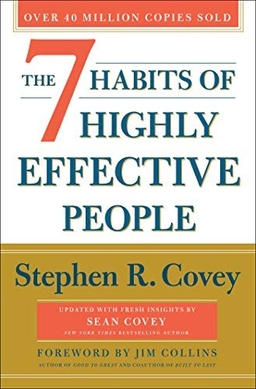
The 7 Habits of Highly Effective People
Stephen R. Covey
- Pages
- 432
- Focus
- Stephen Covey spent his career studying success literature and noticed something troubling: 20th-century success literature focused on techniques and quick fixes — the 'Personality Ethic.' 19th-century literature focused on character — the 'Character Ethic.' His argument: sustainable effectiveness requires the latter. The seven habits move from dependence to independence to interdependence — starting with internal victories (be proactive, begin with the end in mind, put first things first) before moving to external ones (think win-win, seek first to understand). Published 1989. Over 40 million copies. Required reading in more MBA programs than any other book. The most influential business book of the 20th century according to multiple surveys.
- Best for
- People who feel productive but not purposeful — busy but not clear on why. Anyone building a career or organization who needs a philosophical framework, not just tactics. Leaders who want to understand why their team doesn't trust them. People in their 20s who want to build on the right foundation before the wrong habits calcify.
- Style
- Philosophical
Getting Things Done
David Allen
- Pages
- 352
- Focus
- David Allen discovered a simple, devastating insight: the reason people feel overwhelmed is not that they have too much to do. It's that their mind is trying to remember all of it simultaneously. Every uncaptured commitment — every 'I should call her back,' 'I need to fix that,' 'I haven't responded to that email' — occupies cognitive RAM. GTD's solution: capture everything into a trusted external system. Not a to-do list. A complete system with inboxes, next-action lists, project lists, and weekly reviews. When your mind no longer has to remember, it can think. Published 2001. Spawned an entire productivity cult. The book that made 'inbox zero' a concept and 'next action' a discipline.
- Best for
- Anyone whose brain feels like a browser with 47 open tabs. Knowledge workers managing multiple projects simultaneously. People who are good at starting things and bad at finishing them. Anyone who has ever woken up at 3am worried about something they forgot to do.
- Style
- Systematic
Similarities
- Trusted systems over willpower. Both argue that relying on memory and motivation is a losing strategy. Covey uses principles and roles as his external scaffolding; Allen uses capture tools and lists. Both move the cognitive load outside your head.
- The weekly review. Both books prescribe a regular review ritual — stepping back from the daily grind to assess where you are, what matters, and what's next. Covey calls it 'sharpening the saw'; Allen calls it the Weekly Review. Same function, different vocabulary.
- Clarity as the goal. Both books promise the same outcome: the peace of mind that comes from knowing you have a complete picture of your commitments and have made conscious choices about what to do next.
Differences
- Values vs mechanics. 7 Habits starts with who you want to be and works toward systems. GTD starts with your inbox and never asks who you want to be. One is a philosophy of life; the other is an operating system. You can run GTD without values; you can have Covey's values without any system.
- Slow vs fast. 7 Habits is a slow, deep read — meant to be absorbed and meditated on. GTD is a dense reference manual that you implement, iterate, and return to. One changes your thinking; the other changes your workflow.
- Timeless vs dated. Covey's principles are as applicable now as in 1989 — human nature hasn't changed. Allen's specific tools (paper trays, tickler files) feel increasingly analog. The principles of GTD are timeless; the implementation needs translation for 2024.
Our Verdict
Read 7 Habits first to figure out what matters — then read GTD to build a system that ensures it actually gets done. Without 7 Habits, GTD is just a more sophisticated way to be busy. Without GTD, 7 Habits remains a beautiful intention that never quite manifests. Covey sets the compass. Allen builds the engine. They are the two books that together answer the question: how should I spend my time? One tells you the direction. The other makes sure you move.
Read both: 16 hours