All comparisonsVS
Good to Great
Jim Collins
Built to Last
Jim Collins & Jerry Porras
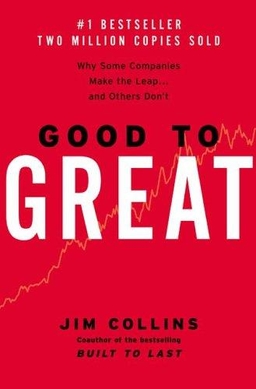
Good to Great
Jim Collins
- Pages
- 300
- Focus
- Jim Collins and his research team spent five years studying 1,435 Fortune 500 companies to find the ones that made a sustained leap from good performance to great — and stayed there for at least 15 years. They found eleven. The patterns were counterintuitive: great companies were led by 'Level 5 Leaders' who combined fierce professional will with personal humility — the opposite of the celebrity CEO. They had the right people before the right strategy. They confronted brutal facts without losing faith (the Stockdale Paradox). They found their Hedgehog Concept: the intersection of what they were passionate about, what they could be best at, and what drove their economic engine. Published 2001. Over 4 million copies. Still the most rigorous study of corporate excellence ever conducted.
- Best for
- Leaders and managers who want to understand what separates sustained excellence from average performance. Anyone building a company or team from scratch. MBA students and executives who want strategic frameworks backed by data, not anecdote. People tired of leadership books built on one company's success story.
- Style
- Research-driven
Built to Last
Jim Collins & Jerry Porras
- Pages
- 368
- Focus
- Built to Last came first — published in 1994 by Collins and his Stanford colleague Jerry Porras — and asked a different question: not how to become great, but how to last. They studied 18 'visionary companies' (3M, Disney, HP, Sony, Walmart) and compared each to a direct competitor that never achieved the same iconic status. The finding: visionary companies are not primarily about profits. They are built around core values and a core purpose that remain fixed while strategies and tactics change. They 'preserve the core and stimulate progress.' They make 'Big Hairy Audacious Goals.' They build a cult-like culture that repels the wrong people and retains the right ones. The book that put 'BHAG' into the business lexicon.
- Best for
- Founders and executives building organizations meant to outlast any single leader or product. Anyone who wants to understand why some companies endure for a century while others fade in a decade. People more interested in organizational DNA than short-term performance metrics.
- Style
- Visionary
Similarities
- Same author, rigorous methodology. Both books are built on the same research foundation: longitudinal studies of real companies with matched comparison sets. Collins brings the same 'find the pattern, not the anecdote' discipline to both. In the business book world, this level of rigor is rare.
- Culture beats strategy. Both books conclude that getting the right people into the right culture matters more than having the right strategy. Great companies win because of who they are, not just what they do.
- Counterintuitive findings. Both books systematically subvert business mythology: the charismatic visionary CEO, the brilliant strategy, the innovative product launch. The real drivers of greatness are slower, deeper, and less glamorous than the covers of business magazines suggest.
Differences
- Transformation vs endurance. Good to Great asks: how does a mediocre company become excellent? Built to Last asks: how does an excellent company stay excellent for 100 years? One is about the leap; the other is about the marathon.
- The leader's role. Good to Great puts enormous emphasis on Level 5 Leadership — the right kind of leader is essential to the transition. Built to Last argues that truly visionary companies don't depend on any single visionary leader — the institution itself must carry the vision.
- Actionable vs aspirational. Good to Great's frameworks — hedgehog concept, flywheel, stockdale paradox — are immediately applicable to most organizations. Built to Last's BHAG and core ideology are inspiring but require a longer time horizon to implement and evaluate.
Our Verdict
Read Good to Great first — its frameworks are more immediately actionable and its research more recent. Then read Built to Last to understand the longer arc: what you're building toward, not just how to get moving. Collins wrote them in reverse chronological order (Good to Great came second but studied an earlier stage). Read them in logical order: Built to Last for the destination, Good to Great for the journey. Together they are the most complete picture of organizational excellence that business research has produced.
Read both: 12 hours