All comparisonsVS
Flow
Mihaly Csikszentmihalyi
Deep Work
Cal Newport
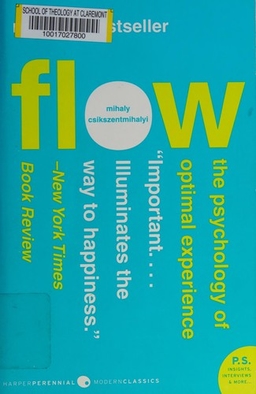
Flow
Mihaly Csikszentmihalyi
- Pages
- 303
- Focus
- In 1975, a Hungarian psychologist with an unpronounceable name began asking a question nobody had thought to ask: what makes some moments in life genuinely worth living? His answer, after decades of interviews with surgeons, chess players, rock climbers, factory workers, and musicians: flow — the state of complete absorption where self-consciousness disappears, time distorts, and performance peaks. Csikszentmihalyi (chick-SENT-me-high) showed that happiness isn't found in relaxation or wealth — it's found in optimal challenge: tasks hard enough to require skill but not so hard they cause anxiety. Published 1990. Translated into 30 languages. The book that turned 'being in the zone' from a sports cliché into a science.
- Best for
- Anyone who has ever lost track of time doing something they love and wanted to understand why. Readers interested in the psychology of happiness, creativity, and peak performance. Artists, athletes, programmers, and anyone who wants more of those rare moments when everything clicks — and a scientific framework for engineering them.
- Style
- Psychological
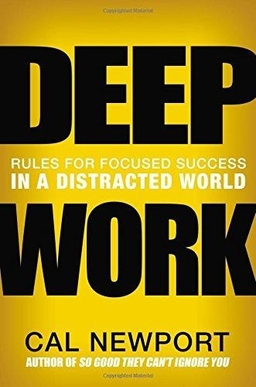
Deep Work
Cal Newport
- Pages
- 296
- Focus
- Cal Newport is a computer science professor who has never had a social media account. His thesis: the ability to focus without distraction on cognitively demanding tasks is both increasingly rare and increasingly valuable — making it, in his term, a 'superpower' in the modern economy. Deep Work argues that most knowledge workers have traded their capacity for sustained concentration for the shallow busyness of email, meetings, and social media — and are paying an enormous professional price. His case studies range from Carl Jung (who built a stone tower in the Swiss countryside to do his deepest thinking) to J.K. Rowling (who locked herself in a hotel room to finish Harry Potter). The rules that follow are demanding, specific, and effective.
- Best for
- Knowledge workers who feel their ability to concentrate has been quietly eroding for years. Anyone who ends a workday exhausted but unable to point to what they actually produced. Writers, programmers, researchers — anyone whose work requires sustained cognitive effort and who wants a practical system for protecting it.
- Style
- Analytical
Similarities
- Deep focus as peak state. Both books describe the same phenomenology: total absorption in a task, loss of self-consciousness, distorted time perception. Csikszentmihalyi calls it flow; Newport calls it deep work. They're studying the same mental state from different angles.
- Against shallow engagement. Both argue that surface-level distraction — mindless scrolling, passive entertainment, shallow work — is the enemy of both meaning and performance. The path to excellence runs through depth.
- Skill meets challenge. Both argue that the optimal state requires a match between your skill level and task difficulty. Too easy = boredom. Too hard = anxiety. The sweet spot is where both flow and deep work live.
Differences
- Psychologist vs productivity strategist. Csikszentmihalyi asks: what is the good life? His answer involves flow as a source of meaning and happiness. Newport asks: how do I produce excellent work? His answer involves deep work as a professional strategy. Same zone, radically different purpose.
- Intrinsic vs instrumental. Flow is valuable in itself — the experience is the point. Deep work is valuable for what it produces — the output is the point. One is a theory of happiness; the other is a theory of professional success.
- Discovery vs system. Flow describes a natural psychological phenomenon and explains why it matters. Deep Work prescribes a set of habits and rules to engineer it deliberately. One is the map; the other is the method.
Our Verdict
Read Flow to understand why deep absorption is one of the most valuable experiences a human can have — and why you keep chasing it. Read Deep Work to build the systems that make it happen reliably in your professional life. Flow gives you the 'why' in existential terms. Deep Work gives you the 'how' in practical ones. Together they are the complete picture: the state you're aiming for and the architecture that gets you there.
Read both: 11 hours