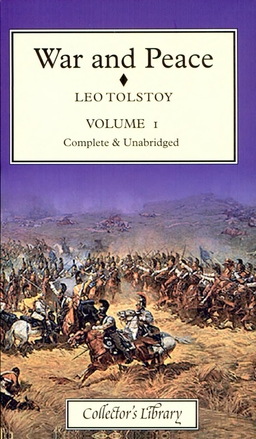
War and Peace
Leo Tolstoy
Anna Karenina
Leo Tolstoy
War and Peace
Leo Tolstoy
- Pages
- 1225
- Focus
- The biggest novel ever attempted — and the one that succeeded. Five aristocratic families, Napoleon's invasion of Russia, hundreds of characters, battles that shake the earth, and drawing-room conversations that shake the soul. Tolstoy wrote it between 1865 and 1869, rewrote it seven times, and created something that every serious novelist since has measured themselves against. 1,225 pages that contain, as one critic said, 'not a novel but life itself.'
- Best for
- Readers who are ready for the Mount Everest of literature and want the richest reading experience a novel can provide. NOT for everyone — and that's okay. But if you have the patience, this is the book that rewards it more than any other in existence.
- Style
- Panoramic
Anna Karenina
Leo Tolstoy
- Pages
- 864
- Focus
- 'All happy families are alike; each unhappy family is unhappy in its own way.' The most famous opening line in literature begins the most psychologically devastating novel ever written. Anna — beautiful, intelligent, trapped in a loveless marriage — falls for the dashing Count Vronsky and watches as love, society, jealousy, and her own mind destroy her. Alongside her story, the farmer Levin searches for meaning in work, faith, and family. Tolstoy wrote both — the destruction and the redemption — with equal genius.
- Best for
- Readers who want to experience Tolstoy at his most humanly devastating without committing to 1,225 pages. Anna Karenina is the entry point to Russian literature for a reason: it's more focused, more emotionally immediate, and its central question — can a woman survive defying the rules of her society? — hits as hard in 2026 as it did in 1877.
- Style
- Devastating
Similarities
- Both are regularly voted the greatest novel ever written — they trade the #1 spot depending on which list you consult. In a 2007 TIME survey of 125 authors, Anna Karenina was voted #1. In many other polls, War and Peace takes it. The point: these are the two peaks of the mountain, and arguing which is taller misses the view
- Both showcase Tolstoy's terrifying ability to put you INSIDE a character's mind — you don't just read what characters think; you think their thoughts as if they were your own. No author before or since has matched this. When Anna spirals into jealousy, you spiral with her. When Pierre stares at the sky after a battle, you stare with him. It's not empathy — it's possession
- Both use dual-plotline structures — War and Peace weaves the stories of Pierre, Prince Andrei, and Natasha against the backdrop of the Napoleonic Wars. Anna Karenina interleaves Anna's tragic affair with Levin's search for meaning in rural life. In both novels, the 'second story' is where Tolstoy hides his deepest ideas about how to live
- Both are novels about Russian high society in the 19th century — and yet both are so universally human that they resonate across every culture and century. You don't need to know anything about Russian history to be devastated by Anna's fate or transformed by Pierre's search for meaning. Tolstoy wrote about aristocrats but captured something eternal
- Both demand patience and reward it beyond anything else in literature — neither is a quick read, both have slow stretches, and both contain passages that seem to digress into philosophy or farming. But readers who push through unanimously say the same thing: 'I finished the book and felt like I had lived another life.' No other author delivers this at this scale
Differences
- War and Peace is a TELESCOPE — it pulls back to show you the sweep of history: Napoleon's invasion, Borodino, the burning of Moscow, the retreat. Individual lives are caught in forces they can't control. Anna Karenina is a MICROSCOPE — it zooms into the human heart and examines every cell of love, jealousy, shame, and despair. One shows you the world; the other shows you yourself
- War and Peace is 1,225 pages and includes extended philosophical essays on history, free will, and the nature of power — Tolstoy literally stops the novel to argue with historians about why Napoleon lost. Some readers love these digressions; others skip them. Anna Karenina is 864 pages and NEVER breaks character — every idea is embedded in the story. This makes it more consistently readable, though shorter only by comparison
- The emotional experience is different. War and Peace leaves you feeling EXPANDED — you've lived through battles, fallen in love, questioned the meaning of existence, and come out the other side seeing the world as bigger and more mysterious. Anna Karenina leaves you feeling SHATTERED — Anna's descent is so believable, so incremental, so inevitable that you'll put the book down in the last hundred pages feeling physically sick. One gives you wonder; the other gives you grief
- Accessibility: Anna Karenina is the easier entry. The story is gripping from page one (that opening line!), the plot moves steadily, and the emotional stakes are clear. War and Peace requires commitment — the first 200 pages introduce dozens of characters at a Moscow party, and many readers bounce here. If you've never read Tolstoy, Anna Karenina is the door. War and Peace is the cathedral you find on the other side
- Tolstoy's personal relationship to each book: he was in his 30s and in love with life when he wrote War and Peace — the novel overflows with vitality, hope, and a belief that meaning can be found. He was in his late 40s and increasingly tortured by existential questions when he wrote Anna Karenina — the novel is darker, more psychologically ruthless, and ends with both destruction and an uneasy faith. You can feel him aging between the two books
Our Verdict
Start with Anna Karenina. This isn't debatable for most readers. It's shorter, faster, more emotionally gripping, and contains one of the greatest character studies in all of fiction. Anna's story will stay with you for years — her intelligence, her passion, her slow unraveling. Levin's parallel story of searching for meaning in work, family, and faith is Tolstoy at his wisest. Together they form a novel so complete it feels like it contains everything important about being human. Then — when you're ready, and there's no rush — read War and Peace. It's the larger, more ambitious, more demanding book. It will take you weeks, not days. You will want to quit somewhere around page 300. Don't. What waits on the other side is the richest reading experience in existence. Pierre Bezukhov's journey from confused young man to someone who finds peace is worth every page. Together: about 38 hours. The price of reading the two greatest novels ever written — and having your inner life permanently altered by a man who died in 1910 but understood you better than you understand yourself.