Thinking, Fast and Slow
Daniel Kahneman
Predictably Irrational
Dan Ariely
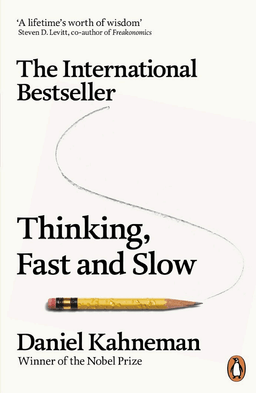
Thinking, Fast and Slow
Daniel Kahneman
- Pages
- 499
- Focus
- The Nobel Prize winner who invented behavioral economics spent 40 years proving that your brain lies to you — systematically, predictably, and constantly. System 1 (fast, intuitive, emotional) and System 2 (slow, deliberate, logical) are the two engines running your mind, and they are in constant conflict. This is the book that made 'cognitive bias' a dinner-table phrase. 499 pages that will make you distrust every decision you've ever made.
- Best for
- Serious readers who want the definitive, foundational work on human irrationality. This is NOT a light read — it's dense, academic, and occasionally grueling. But it's the single most important book on decision-making ever written. If you work in finance, medicine, law, management, or any field where bad judgment costs money or lives — this book is mandatory.
- Style
- Rigorous
Predictably Irrational
Dan Ariely
- Pages
- 349
- Focus
- Why do we overpay for things when 'FREE!' is attached? Why does a $2 aspirin kill your headache but a 1-cent aspirin doesn't? Why do we cheat just a little but not a lot? Dan Ariely — an MIT behavioral economist who recovered from severe burns and became fascinated by how pain changes perception — runs clever, often hilarious experiments to prove that human irrationality isn't random. It's predictable. And once you see the patterns, you can't unsee them.
- Best for
- Anyone who loved Freakonomics and wants more. Perfect as your FIRST behavioral economics book — it's fun, fast, and every chapter is a self-contained experiment with a clear 'aha' moment. Best for readers who want to understand their own irrational behavior without wading through academic papers.
- Style
- Playful
Similarities
- Both proved the same heretical idea: humans are NOT rational actors. Classical economics assumed we make optimal choices. Kahneman and Ariely spent their careers proving that's a fantasy — and both won enormous academic acclaim for it (Kahneman: Nobel Prize; Ariely: one of the most-cited behavioral scientists alive)
- Both use controlled experiments as proof — no hand-waving, no anecdotes dressed as evidence. Kahneman ran experiments with Amos Tversky for decades (their partnership is one of the great intellectual love stories). Ariely designs experiments so clever they feel like magic tricks. In both books, every claim comes with data
- Both will change how you make decisions tomorrow — not theoretically, but practically. After Kahneman, you'll notice 'anchoring' every time you see a price tag. After Ariely, you'll understand why 'free shipping' makes you buy things you don't need. These books don't just inform — they permanently alter your perception
- Both became massive crossover hits — academic books that normal people actually read. Thinking, Fast and Slow: 10M+ copies, translated into 40+ languages. Predictably Irrational: 5M+ copies, spawned a TED talk with 5M+ views. Both proved that behavioral science can be as gripping as any thriller
- Both share the same mission: making you a better decision-maker by making you distrust your instincts. The first step to rationality is accepting how irrational you are — and both books are designed to shatter your confidence in your own judgment
Differences
- Kahneman wrote the TEXTBOOK; Ariely wrote the INTRODUCTION. Thinking, Fast and Slow is the comprehensive, authoritative, cover-everything work — 499 pages covering loss aversion, anchoring, framing, prospect theory, the planning fallacy, the experiencing self vs the remembering self. Predictably Irrational is 349 pages of greatest hits — one fun experiment per chapter, clean takeaway, move on. The depth gap is enormous
- Reading difficulty: Kahneman is HARD. Full stop. Dense paragraphs, complex experimental setups, sections where you need to re-read three times. Many readers quit midway — it's the book everyone buys and half the people finish. Ariely is EASY — written like a conversation, experiments that make you laugh, chapters you can read in 20 minutes. This isn't a quality difference; it's an accessibility difference
- Kahneman builds a UNIFIED THEORY of the mind (System 1 vs System 2) — everything connects. By the end, you have a mental model for how ALL of human cognition works. Ariely presents STANDALONE EXPERIMENTS — each chapter reveals one specific irrationality (the decoy effect, the power of free, the IKEA effect). No grand theory, but each insight is immediately applicable
- Tone: Kahneman writes with the careful precision of a scientist who knows his critics will check every claim. There's a melancholy to it — he often admits when even he can't overcome the biases he discovered. Ariely writes with the enthusiasm of a professor who loves watching students' faces when they realize they've been tricked. One is somber wisdom; the other is gleeful discovery
- The personal stakes: Kahneman's book is haunted by the death of his research partner Amos Tversky — the book is secretly a tribute to their decades of collaboration. Ariely's book is shaped by his recovery from burns covering 70% of his body — the experience of being a patient made him question everything about how humans perceive pain, pleasure, and choice. Both books carry emotional weight that most science books never achieve
Our Verdict
Here's the honest recommendation: read Predictably Irrational first. It's more fun, more accessible, and every chapter gives you a clear 'I do that!' moment. It will hook you on behavioral economics in about 6 hours. Then — and this matters — read Thinking, Fast and Slow. Yes, it's harder. Yes, you might need three weeks instead of three days. But it's the most important book on the human mind published in the last 50 years. Kahneman's System 1/System 2 framework will become part of how you think about thinking itself. The difference is this: Ariely teaches you 15 specific ways you're irrational. Kahneman teaches you WHY you're irrational, at the deepest level, and why you can't fully fix it. Together: about 15 hours. The price of finally understanding why smart people — including you — make dumb decisions.