Sapiens
Yuval Noah Harari
Homo Deus
Yuval Noah Harari
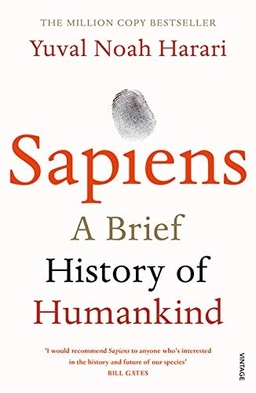
Sapiens
Yuval Noah Harari
- Pages
- 443
- Focus
- How did a mediocre ape from the African savanna end up ruling the planet? Harari's answer — we learned to tell stories. Money, religion, nations, human rights — all are 'shared fictions' that allow millions of strangers to cooperate. 25 million copies sold. Recommended by Barack Obama, Bill Gates, and Mark Zuckerberg. The book that made history feel like a thriller.
- Best for
- Anyone who has ever looked at the news and thought: 'How did we end up here?' Sapiens gives you a 70,000-year answer. Best for curious generalists who want one book that connects the Agricultural Revolution, the rise of capitalism, and the smartphone in your pocket.
- Style
- Sweeping
Homo Deus
Yuval Noah Harari
- Pages
- 449
- Focus
- Now that humanity has conquered famine, plague, and war (statistically, not perfectly), what's next? Harari's answer is terrifying: we'll pursue immortality, happiness, and divinity — and in doing so, we might make most humans economically and militarily useless. The sequel to Sapiens that Silicon Valley reads as a roadmap and everyone else reads as a warning.
- Best for
- Readers who finished Sapiens and couldn't stop thinking about it. Also for anyone working in tech, AI, or biotech who wants to see the 100-year consequences of what they're building. This book will make you uncomfortable — that's the point.
- Style
- Prophetic
Similarities
- Both are by the same author and share Harari's signature move: taking something you think you understand (money, happiness, religion, data) and showing you that you've been thinking about it completely wrong
- Both are built on the same core thesis — that 'shared fictions' (myths, ideologies, economic systems) are the operating system of civilization. Sapiens shows how this OS was installed; Homo Deus asks what happens when algorithms replace it
- Both sold tens of millions of copies by making Big Ideas accessible — Harari writes like a brilliant dinner party guest, not like a professor. No footnotes, no hedging, no academic caution. He makes sweeping claims and dares you to disagree
- Both will ruin your next dinner party — after reading either book, you won't be able to hear someone say 'human rights are sacred' or 'the economy will grow forever' without mentally adding '...but that's just a story we agreed on'
- Both were praised and criticized for the same reason: Harari simplifies. Specialists in every field he touches (biology, economics, AI) can find things to argue with. But the synthesis — the ability to connect dots across disciplines — is what makes both books extraordinary
Differences
- Sapiens is a REARVIEW MIRROR — it explains where we came from. Homo Deus is a WINDSHIELD — it shows where we're going. One makes you understand the present by understanding the past; the other makes you fear the future by understanding the present
- Sapiens ends on a note of wonder (look what this species achieved). Homo Deus ends on a note of existential dread (look what this species is about to do to itself). If Sapiens is a celebration, Homo Deus is an intervention
- Sapiens is universally loved — almost no one regrets reading it. Homo Deus is more polarizing — some readers find Harari's predictions about 'useless humans' and 'dataism' depressing or far-fetched. The first book makes you proud to be human; the second makes you wonder how long that will matter
- Sapiens covers 70,000 years and feels fast. Homo Deus covers maybe 200 years of future and feels slower — Harari spends more time building arguments and less time telling stories. The pacing shifts from narrative to philosophical essay, which some readers love and others find laborious
- The core question is different. Sapiens asks: 'What makes Homo sapiens special?' (Answer: our ability to believe in fictions together.) Homo Deus asks: 'What happens when algorithms understand us better than we understand ourselves?' (Answer: we might worship data the way we once worshipped gods.)
Our Verdict
Read Sapiens first. This is non-negotiable — it's one of the most important books of the 21st century, and Homo Deus assumes you've read it. Sapiens will give you a new operating system for understanding history, economics, religion, and human cooperation. You'll finish it seeing the world differently. Then read Homo Deus, but with a warning: it's a darker, slower, more philosophical book. Some readers find it even better than Sapiens because it asks harder questions. Others find it repetitive or depressing. Either way, the central argument — that humanity's next project is upgrading Homo sapiens into Homo deus, and that most humans might become irrelevant in the process — is something everyone should wrestle with before the future arrives. Together: about 16 hours. The most mind-expanding weekend you can have without leaving your couch.