Man's Search for Meaning
Viktor Frankl
The Power of Now
Eckhart Tolle
Man's Search for Meaning
Viktor Frankl
- Pages
- 184
- Focus
- Viktor Frankl survived Auschwitz. His wife, father, mother, and brother did not. In the camps, he observed something that changed psychology forever: the prisoners who survived weren't the strongest or the youngest — they were the ones who found MEANING in their suffering. From this observation, he built logotherapy — the idea that the primary drive of human life is not pleasure (Freud) or power (Adler) but meaning. 16 million copies sold. The Library of Congress named it one of the ten most influential books in America.
- Best for
- Anyone going through suffering — grief, illness, job loss, depression, existential crisis — and wondering if there's any point. This is the book therapists recommend more than any other. It doesn't promise that life will get easier; it promises that it can have meaning even when it doesn't. Also: at 184 pages, it takes a single afternoon to read. It may take a lifetime to fully absorb.
- Style
- Unflinching
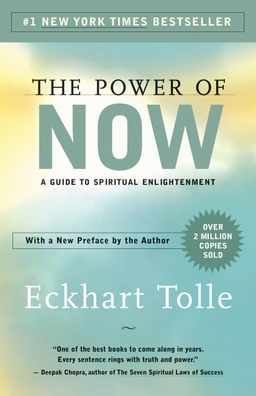
The Power of Now
Eckhart Tolle
- Pages
- 236
- Focus
- At 29, Eckhart Tolle was consumed by suicidal depression. One night, the thought arose: 'I cannot live with myself any longer.' Then he noticed: who is the 'I' and who is the 'self' it can't live with? That question dissolved his identity, and he woke up in a state of profound peace. The Power of Now is his guide to the same experience: stepping out of the thinking mind and into the present moment, where suffering — which is always about the past or the future — cannot exist.
- Best for
- Anyone trapped in anxiety about the future or regret about the past — which is almost everyone. Especially powerful for overthinkers, chronic worriers, and people whose minds run a 24/7 commentary track of fear and self-criticism. This book won't fix your problems — it will show you that most of your 'problems' are thoughts about the future that haven't happened yet.
- Style
- Awakening
Similarities
- Both are about the same question — the biggest question a human being can ask: how do I find peace when life is painful? Frankl's answer: find meaning in the pain. Tolle's answer: step outside the mind that creates the pain. Different paths, same mountain — and both have guided millions of people through their darkest moments
- Both were born from extreme personal suffering — Frankl survived the Holocaust and lost his entire family. Tolle survived suicidal depression and a complete psychological breakdown. Neither wrote from theory; both wrote from the other side of experiences that destroy most people. This gives both books an authority that no self-help book can match
- Both are short (184 and 236 pages) yet contain more wisdom per page than books ten times their length — both have been read, reread, annotated, and given away by millions of people who describe them as 'the book that changed my life.' Both are books you can't really 'finish' — you return to them at different stages of life and find different things
- Both reject the modern obsession with happiness as a goal — Frankl says: 'Don't aim at success — the more you aim at it and make it a target, the more you are going to miss it.' Tolle says: 'The primary cause of unhappiness is never the situation but your thoughts about it.' Both argue that chasing happiness IS the problem
- Both have transcended their genres — Frankl's book is shelved in psychology, philosophy, Holocaust literature, AND self-help. Tolle's book is shelved in spirituality, mindfulness, AND psychology. Neither fits neatly into a category because both are trying to address something that categories can't contain: the human experience of suffering
Differences
- Frankl says: FIND MEANING in suffering — your pain is not pointless; it's asking you to grow. He quotes Nietzsche: 'He who has a why to live can bear almost any how.' The answer to suffering is PURPOSE. Tolle says: DISSOLVE the identity that suffers — your pain is real but the 'you' who suffers is a mental construction. Step out of thought and pain has no one to inhabit. The answer to suffering is PRESENCE. One transforms pain; the other transcends it
- Frankl writes from the WORST experience a human being can have — Auschwitz, starvation, watching his loved ones die. His authority is absolute: if meaning can be found THERE, it can be found anywhere. Tolle writes from an INNER experience — depression, existential despair, the torment of an overactive mind. His suffering was real but psychological, not physical. Frankl validates suffering as meaningful. Tolle deconstructs suffering as illusory
- Frankl is ACTIVE — find your purpose, take responsibility, choose your response to circumstances. His philosophy demands that you DO something with your pain. Tolle is RECEPTIVE — stop doing, stop thinking, stop resisting. His philosophy demands that you SURRENDER your compulsion to solve everything. Frankl says: engage with life. Tolle says: let life engage with you. One is Western; the other is Eastern
- Man's Search for Meaning is a DOCUMENT — the first half is a Holocaust memoir that reads like testimony. It's factual, specific, and grounded in events that actually happened to real people. The Power of Now is a TEACHING — it's structured as a dialogue between teacher and student, with no specific events or timelines. One is rooted in history; the other is timeless. One has characters; the other has concepts
- The emotional aftermath: Man's Search for Meaning leaves you feeling RESOLUTE — 'If he could find meaning in Auschwitz, I can find meaning in my problems.' It doesn't make you happy; it makes you strong. The Power of Now leaves you feeling PEACEFUL — or confused, or both. It's a book that either shifts something in you on first reading or doesn't connect at all. Frankl works for everyone; Tolle works profoundly for some
Our Verdict
Read Man's Search for Meaning first. This is non-negotiable. It's 184 pages, it takes one afternoon, and it will permanently change how you think about suffering. Frankl's insight — that meaning can be found in even the most terrible circumstances, and that this meaning is what keeps people alive — is the most important idea in modern psychology. The Holocaust memoir section will haunt you. The logotherapy section will give you a framework for your own life. It's the single most recommended book by therapists worldwide, and for good reason. Then read The Power of Now when you're ready for a different kind of answer. Tolle's approach — stepping out of compulsive thinking and into present-moment awareness — won't replace Frankl's meaning-based approach; it will complement it. Frankl gives you a reason to endure. Tolle gives you a way to stop fighting yourself. Together: about 8 hours. Two answers to the question that matters most — and both might save your life.