All comparisonsVS
The Hitchhiker's Guide to the Galaxy
Douglas Adams
The Martian
Andy Weir
The Hitchhiker's Guide to the Galaxy
Douglas Adams
- Pages
- 216
- Focus
- The Earth is demolished to make way for a hyperspace bypass. Arthur Dent escapes in his bathrobe. The answer to life, the universe, and everything is 42. Douglas Adams wrote the funniest science fiction novel ever published — a book so quotable that 'Don't Panic' became a cultural mantra and 'mostly harmless' became Earth's encyclopedia entry. Originally a BBC radio series (1978), then a novel (1979), then a trilogy in five parts. 16 million copies sold. The book that proved sci-fi could be hilarious.
- Best for
- Anyone who needs to laugh — genuinely, absurdly, helplessly laugh — while reading about the end of the world. Perfect for readers who think science fiction is too serious. Also: the greatest cure for existential dread ever written. If the universe is meaningless, Adams argues, you might as well have a good time.
- Style
- Absurd
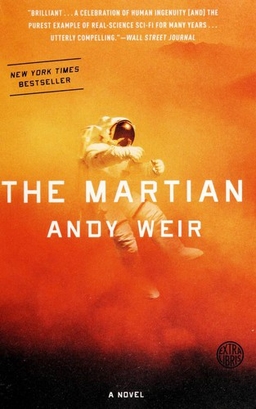
The Martian
Andy Weir
- Pages
- 369
- Focus
- Mark Watney is stranded alone on Mars with limited supplies, no way to communicate with Earth, and every system slowly failing. His response: science, duct tape, and the most relentlessly optimistic inner monologue in fiction. Andy Weir self-published on his blog, readers shared it, Hollywood called. $630M film with Matt Damon. The book that made engineering feel like a superpower.
- Best for
- Anyone who loved MacGyver and wished he was funnier. Readers who want to feel smarter after finishing a book — Weir walks you through real orbital mechanics, botany, and chemistry in a way that makes you feel like YOU could survive on Mars.
- Style
- Resourceful
Similarities
- Both are comedic science fiction — and together they define the two ways humor works in sci-fi. Adams uses absurdity (the universe is ridiculous, so laugh at it). Weir uses competence (the universe is trying to kill you, so outsmart it and crack jokes). Both prove that funny sci-fi can be just as profound as serious sci-fi
- Both feature an ordinary, relatable guy thrown into an extraordinary situation — Arthur Dent is a perfectly average Englishman who just wanted his morning tea. Mark Watney is a perfectly average botanist who just wanted to do his job. Neither is a hero archetype — they're regular people dealing with absurd circumstances
- Both became beloved cult-to-mainstream hits — Hitchhiker's started as a BBC radio series and became a 16M-copy publishing phenomenon. The Martian started as a free blog serial and became a $630M Ridley Scott film. Both prove that the best stories find their audience regardless of where they start
- Both use humor as a survival mechanism — Arthur copes with the destruction of Earth by clinging to his Britishness and his towel. Watney copes with dying alone on Mars by cracking jokes in his log entries. In both books, comedy isn't decoration — it's the characters' way of staying sane
- Both are unputdownable despite having almost no traditional action — no laser battles, no alien wars. Hitchhiker's is powered by wit and ideas. The Martian is powered by problem-solving. Both prove you don't need explosions to create tension — you need a voice readers can't stop listening to
Differences
- Adams is a PHILOSOPHER in comedian's clothing — beneath the jokes about Vogon poetry, Hitchhiker's Guide is about the absurdity of existence, the futility of bureaucracy, and the cosmic insignificance of humanity. Monty Python meets Camus. Weir is an ENGINEER in comedian's clothing — beneath the jokes about disco and potato farming, The Martian is about the triumph of human ingenuity over indifferent physics. Apollo 13 meets stand-up
- The humor is fundamentally different. Adams is ABSURDIST — his jokes come from the universe being ridiculous ('The ships hung in the sky in much the same way that bricks don't'). Weir is OBSERVATIONAL — his jokes come from a real person reacting to insane situations. One makes you laugh at existence; the other makes you laugh at human stubbornness
- Hitchhiker's Guide is PLOTLESS by design — Adams never cared about narrative structure. The story meanders through improbable events connected by wit. The Martian is HYPER-PLOTTED — every chapter is a problem, every problem has a scientific solution, every solution creates the next problem. One is jazz; the other is engineering
- The worldview is opposite. Adams: the universe is meaningless, arbitrary, and run by idiots — and that's fine. Weir: the universe is governed by physics, physics can be understood, and understanding is power. One is British nihilism; the other is American can-do
- Legacy: Hitchhiker's influenced COMEDY — Terry Pratchett, Neil Gaiman, and every funny sci-fi writer since owes Adams a debt. The Martian influenced HARD SCI-FI — it launched a wave of scientifically rigorous survival fiction. Adams changed how sci-fi talks. Weir changed what sci-fi talks about
Our Verdict
Read Hitchhiker's Guide first if you need to laugh RIGHT NOW. It's 216 pages, you'll finish it in an evening, and lines like 'Time is an illusion. Lunchtime doubly so' will live in your head forever. Read The Martian first if you want to feel inspired — it's the most uplifting book about almost dying alone that you'll ever read. Together: about 11 hours. Two answers to 'What do you do when the universe is trying to kill you?' Adams says: laugh. Weir says: calculate. Both are correct.
Read both: 11 hours