Fahrenheit 451
Ray Bradbury
The Handmaid's Tale
Margaret Atwood
Fahrenheit 451
Ray Bradbury
- Pages
- 194
- Focus
- In the future, firemen don't put out fires — they start them. Their job is burning books. Guy Montag has been a fireman for ten years without questioning it. Then he meets a girl who asks: 'Are you happy?' He isn't. Written in 1953 on a rented typewriter in a library basement, this is Bradbury's warning about a world that chooses entertainment over thought, speed over reflection, and comfort over truth.
- Best for
- Anyone who has ever felt that the world is getting louder, faster, and shallower — and suspected that's not an accident. At 194 pages, it's a single-sitting read that will haunt you for weeks.
- Style
- Poetic
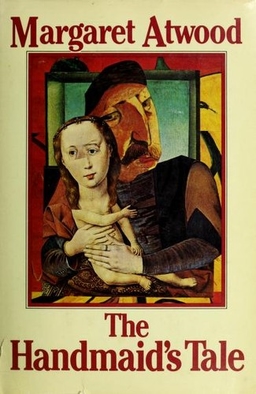
The Handmaid's Tale
Margaret Atwood
- Pages
- 311
- Focus
- The United States has been overthrown by a theocratic dictatorship called Gilead. Women have lost all rights. Fertile women are assigned to Commanders as 'handmaids' — their sole purpose is reproduction. Offred remembers her old life and tries to survive in a world where remembering is an act of resistance. Published 1985. Hulu's adaptation won 8 Emmys. The red robes and white bonnets became real-world protest symbols.
- Best for
- Women who have ever felt their autonomy was conditional. Anyone who watched a news headline and thought: 'That sounds like The Handmaid's Tale.' Atwood included nothing in the book that hasn't already happened somewhere in human history.
- Style
- Chilling
Similarities
- Both are among the most important dystopian novels ever written — alongside 1984 and Brave New World, they form the canon of warning fiction. All four are taught in schools, debated in parliaments, and quoted at protests
- Both depict worlds where the crisis ALREADY HAPPENED — Montag and Offred live inside established systems of control. Neither witnesses the revolution; both live in the aftermath. This makes both more unsettling — they show how quickly the unthinkable becomes normal
- Both feature protagonists who begin compliant and awaken slowly — Montag burns books for a decade, Offred follows rules. Both are radicalized by tiny acts. Both argue that awareness itself is rebellion
- Both refuse comfortable endings — Fahrenheit 451 ends with ambiguity, The Handmaid's Tale ends with Offred climbing into a van (freedom or capture, we never know). Both authors understood that a neat resolution would undermine the warning
- Both became more relevant with time — Bradbury's fears about screens and shrinking attention spans feel more accurate in the age of TikTok than in 1953. Atwood's fears about reproductive control and women's rights feel more urgent in 2026 than in 1985. Both books are getting MORE true
Differences
- What's controlled: Fahrenheit 451 bans KNOWLEDGE — books are burned because ideas are dangerous. The Handmaid's Tale bans AUTONOMY — women's bodies are owned by the state. One is about the mind being emptied; the other about the body being owned
- Who controls: In Fahrenheit 451, society controls ITSELF — people stopped wanting to read, and the government merely formalized it. Voluntary dystopia. In The Handmaid's Tale, a fundamentalist minority seizes power through violence. Imposed dystopia. Bradbury blames us; Atwood blames them
- Prose: Bradbury writes like a POET — lyrical, imagistic, sometimes hallucinatory: 'It was a pleasure to burn.' Atwood writes like a WITNESS — precise, controlled: 'We lived, as usual, by ignoring. Ignoring isn't the same as ignorance, you have to work at it.' One is fire; the other is ice
- Gender: Fahrenheit 451 is essentially gender-neutral. The Handmaid's Tale is fundamentally ABOUT gender — the entire system is built on subjugating women. Bradbury wrote about humanity losing its mind. Atwood wrote about half of humanity losing its freedom
- Scale: Fahrenheit 451 is 194 pages — hits like a poem, intense and compressed. The Handmaid's Tale is 311 pages — unfolds slowly, building dread through accumulation. Bradbury is a sprint; Atwood is a slow suffocation
Our Verdict
Read Fahrenheit 451 first — it's shorter (194 pages, one evening), and its warning about voluntary ignorance is the foundation for understanding all other dystopias. Bradbury saw something in 1953 that most didn't understand until smartphones: we don't need a dictator to destroy thought — we'll do it ourselves if the entertainment is good enough. Then read The Handmaid's Tale for the dystopia closest to current reality. Atwood's genius: every element in Gilead has happened in real human history. It's not speculative fiction; it's a collage of facts rearranged into a nightmare. Together: about 9 hours. Two warnings about what we might become — one if we stop thinking, the other if we stop fighting.