Deep Work
Cal Newport
Digital Minimalism
Cal Newport
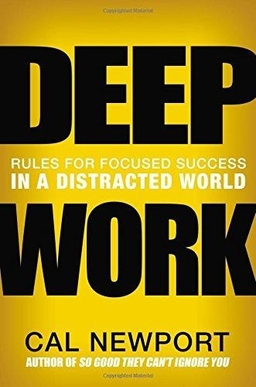
Deep Work
Cal Newport
- Pages
- 296
- Focus
- The ability to focus without distraction on a cognitively demanding task is becoming both increasingly rare and increasingly valuable. Cal Newport — a Georgetown CS professor who has never had a social media account — argues that 'deep work' is the superpower of the 21st century. The book that made 'shallow work' a dirty phrase in every tech company.
- Best for
- Knowledge workers, writers, programmers, researchers, and anyone whose output depends on their ability to think hard. Especially powerful if you've noticed that you can't focus like you used to — that even reading a long article feels difficult now. This book explains why and shows you how to fix it.
- Style
- Analytical
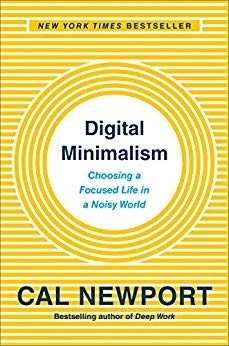
Digital Minimalism
Cal Newport
- Pages
- 284
- Focus
- You check your phone 150+ times a day. You open Instagram 'for one second' and lose 40 minutes. You feel anxious without WiFi. Newport's diagnosis: you didn't choose this relationship with technology — it was engineered by companies that profit from your attention. His prescription: a 30-day digital declutter followed by intentional rebuilding. The anti-smartphone manifesto.
- Best for
- Anyone who has ever said 'I spend too much time on my phone' and meant it. Parents worried about their kids' screen time. People who feel exhausted by social media but can't seem to quit. Anyone who remembers what it felt like to be bored — and misses it.
- Style
- Liberating
Similarities
- Both are by Cal Newport and share his central belief: your attention is the most valuable thing you own, and you're giving it away for free to companies that don't deserve it. He's the rare author who practices what he preaches — no social media, no smartphone notifications, deep focus every morning
- Both are backed by real evidence, not Silicon Valley self-help fluff — Newport cites Carl Jung's stone tower where he wrote his best work, Bill Gates's 'Think Weeks' in an isolated cabin, and the neuroscience of attention residue (why switching between tasks makes you dumber for 20+ minutes)
- Both are contrarian in the same way — in a world that celebrates 'hustle culture,' constant availability, and inbox-zero, Newport says: the best work happens when you're unreachable. The best life happens when you're bored. These ideas feel radical until you try them
- Both give you specific RULES, not vague advice — Deep Work: 'schedule every minute of your day.' Digital Minimalism: '30-day declutter — delete everything, then add back only what passes a strict test.' Newport doesn't trust willpower; he trusts systems
- Both have created real behavioral change — Deep Work spawned 'deep work blocks' in companies like Basecamp and Shopify. Digital Minimalism inspired thousands of people to do the 30-day declutter (Newport's blog is full of their stories). These aren't theoretical books; they're intervention tools
Differences
- Deep Work is about what to DO with your attention — how to produce your best work, how to learn faster, how to become so good at your craft that you're irreplaceable. Digital Minimalism is about what to STOP doing with your attention — how to quit the apps, habits, and reflexes that fragment your mind before you sit down to work
- Deep Work is a CAREER book at its core — the argument is economic: in the new economy, the ability to do deep work is worth more than almost any other skill. Digital Minimalism is a LIFE book — it's about reclaiming your evenings, being present with your family, rediscovering hobbies, learning to be alone with your thoughts again
- Deep Work asks: 'How do I produce at an elite level?' Digital Minimalism asks: 'Why do I feel so scattered and empty?' One is for ambitious professionals who want to level up. The other is for anyone who suspects their phone is stealing their life. Different symptoms, same disease
- The practical prescriptions are different — Deep Work gives you scheduling frameworks (the monastic philosophy, the bimodal philosophy, the rhythmic philosophy, the journalistic philosophy) for carving out focus time. Digital Minimalism gives you a 30-day detox protocol and rules for which technologies to let back in. One restructures your calendar; the other restructures your phone
- Deep Work was written in 2016, before the full scale of the attention crisis was visible. Digital Minimalism was written in 2019, after Newport saw that millions of people couldn't do deep work even if they wanted to — because their phones had rewired their brains first. Digital Minimalism is the prequel that Newport didn't know he needed to write
Our Verdict
Here's the key insight most people miss: these books solve different sides of the same problem, and the order you read them in matters. If you can still focus for an hour without checking your phone, read Deep Work first — it will show you how to turn that focus into career-defining output. If you can't focus for an hour — if you pick up your phone without thinking, if you feel a phantom buzz in your pocket, if you've tried to read a book recently and couldn't get through 20 pages — read Digital Minimalism first. You need to clear the battlefield before you can fight the war. The ideal sequence: Digital Minimalism first (reclaim your attention from the apps), then Deep Work (invest that reclaimed attention in work that matters). Think of it as rehab, then training. Together: about 11 hours. The irony is that if your attention is as fragmented as Newport warns, reading these two books might be the hardest part. Start with 20 minutes a day. Build up. That's the point.